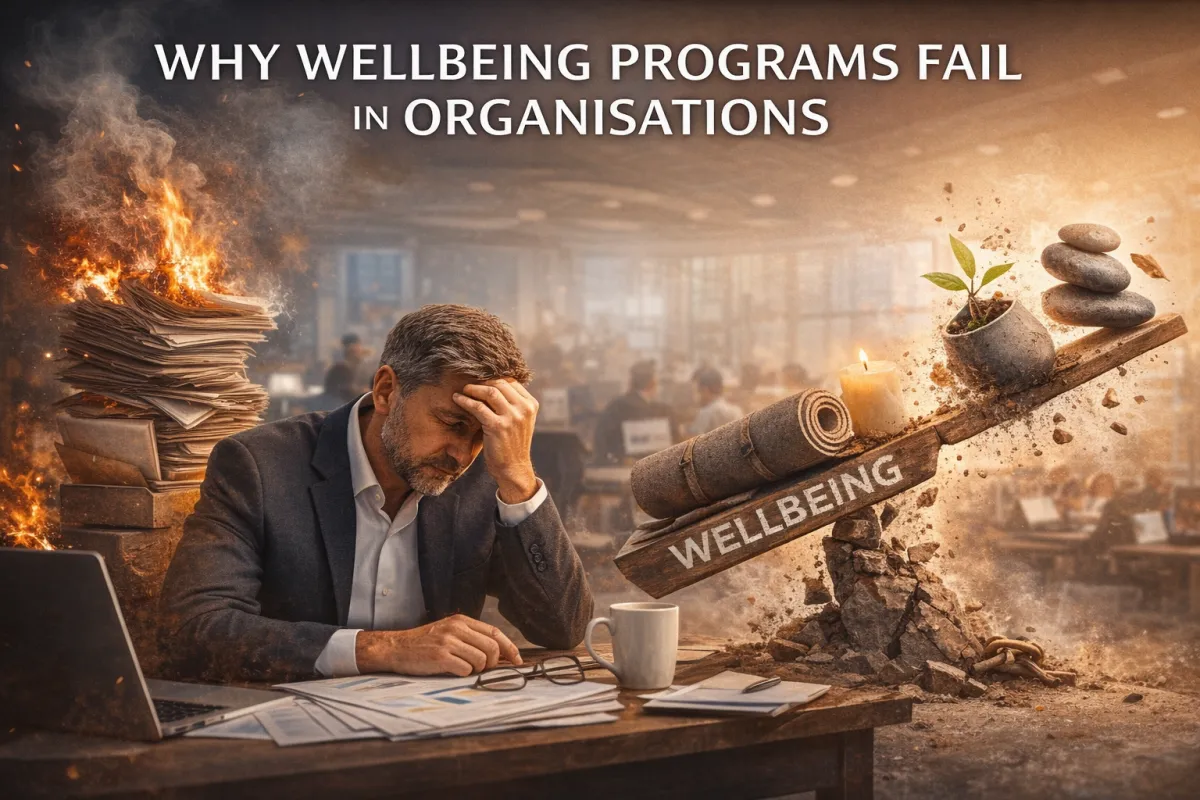
Why Wellbeing Programmes Fail in Organisations
Many organisations now invest in wellbeing.
On paper, this looks like progress. There are workshops, webinars, mindfulness sessions, employee assistance offers, resilience tools, and mental health campaigns. The language is modern, the intention is often good, and yet the deeper pattern remains unchanged: many wellbeing programmes do very little to alter the conditions that are exhausting people in the first place.
That is why so many of them fail.
They fail not because people do not care about wellbeing, but because the intervention is too often separated from the reality of how work is actually being carried.
The problem is usually structural
A stressed employee is invited to attend a session on self-care. A fatigued manager is encouraged to be more resilient. A burned-out team is offered a breathing exercise while the underlying culture remains overloaded, fragmented, and permanently switched on.
This is not a serious response.
If the structure of the work is continuously dysregulating the people inside it, a surface-level wellbeing offer will not solve the problem. At best, it may bring a little temporary relief. At worst, it quietly shifts responsibility back onto the individual, implying that if they are still overwhelmed, they must not be managing themselves well enough.
That is one of the main reasons trust in wellbeing programmes can erode very quickly.
People sense when the offer is genuine support and when it is a cosmetic layer placed over a culture that remains unchanged.
Wellbeing cannot sit outside the way work is organised
The central mistake is this: wellbeing is often treated as an add-on.
It is placed beside the real work rather than inside it.
But if communication is poor, expectations are unrealistic, recovery is absent, emotional strain is ignored, and leaders are themselves dysregulated, then no amount of peripheral wellbeing content will reach the heart of the issue.
The body does not separate these things as neatly as organisations do.
A person’s capacity is shaped by workload, yes, but also by pace, psychological pressure, the tone of leadership, the quality of meetings, relational trust, and whether they are operating in a culture of chronic override.
If those conditions remain untouched, the programme is unlikely to have real impact.
Human beings do not burn out in the abstract
What I have seen again and again in my own work is that burnout and depletion are not abstract states. They are lived through the body.
They show up in breath, posture, patience, emotional range, listening, recovery, and the ability to remain coherent under complexity.
That is why a truly useful organisational response must go deeper than awareness campaigns.
It has to ask:
What is this culture asking human systems to carry?
How much chronic activation is being normalised here?
What is the cost of our communication style, leadership patterns, and pace of work?
Are people being supported to regulate, or only expected to endure?
Those are more uncomfortable questions, but they are the ones that matter.
ENZA is relevant because it addresses the living system
This is where ENZA becomes important.
ENZA offers a way of understanding that human beings and groups are not only cognitive or procedural. They are living systems. State affects communication. Pressure affects perception. Emotional overload affects whether a person can think, collaborate, or recover.
When this is ignored, organisations tend to respond to distress too late and too superficially.
When it is understood, a different level of intervention becomes possible. The work shifts from patching symptoms to recognising patterns in the way the organisation functions and in the way people are expected to carry those patterns in their bodies.
That is a much more serious approach.
What real organisational wellbeing would look like
A meaningful wellbeing strategy would not begin with perks.
It would begin with honesty.
It would look at whether meetings are coherent or draining.
Whether leaders calm the field or tighten it.
Whether communication creates clarity or chronic vigilance.
Whether people are rewarded for healthy capacity or for self-override.
Whether recovery is respected or quietly undermined.
In other words, it would treat wellbeing as inseparable from culture.
That is the difference between symbolic care and real care.
A more useful standard
I am not against wellbeing programmes. I am against the kind that allow organisations to feel progressive without becoming more truthful.
If an organisation genuinely wants healthier people, steadier leadership, and more sustainable performance, it has to move beyond gesture.
It has to examine the embodied reality of the workplace.
That means looking at human capacity, nervous-system load, communication patterns, emotional contagion, leadership tone, and the actual rhythms of the working day.
Without that, wellbeing becomes branding.
With it, wellbeing becomes part of how the organisation lives.
CTA
Lodestone Inside uses frameworks such as ENZA to help organisations move beyond symbolic wellbeing and towards a more embodied, practical approach to culture, communication, and sustainable human capacity.