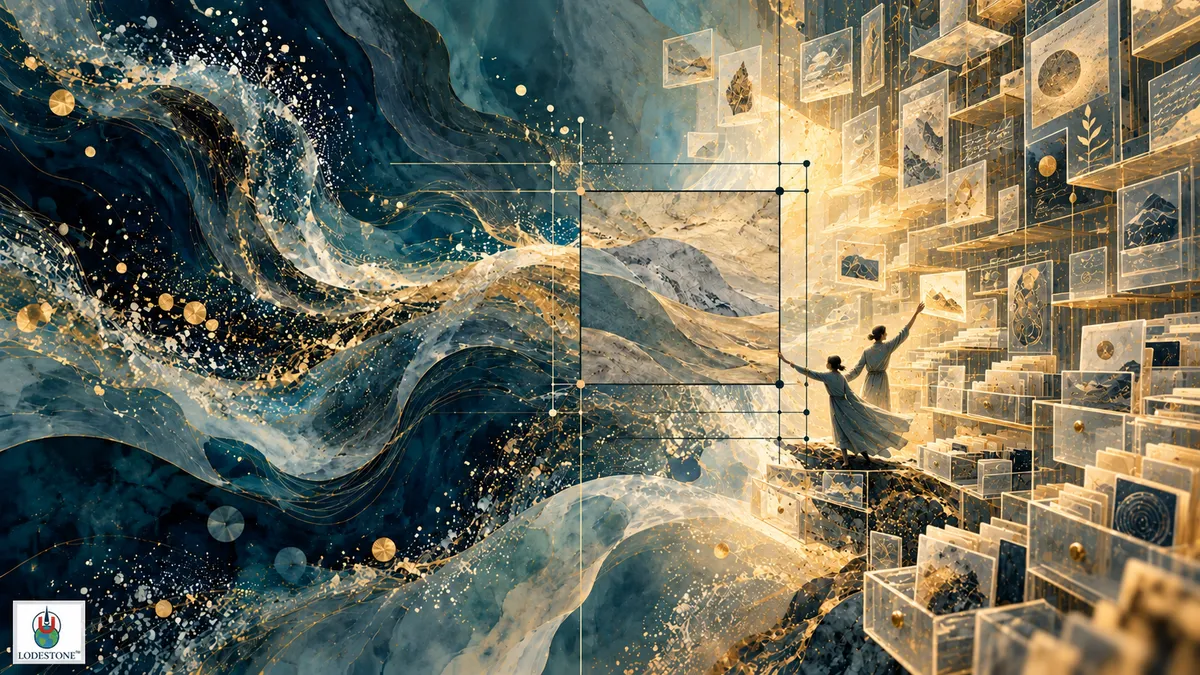
The Human Archivist: When Our Collections Keep us from Receiving Life Anew
Executive summary
Human beings collect images, words, quotations, recordings and knowledge. These collections can help us remember, but they are symbols and shortcuts to experience—not the experience itself. When we become trapped in the limited mind, we may keep looking back through the archive instead of receiving life as it is happening.
Heraclitus’ image of the ever-changing river reminds us that each moment is new. Awareness helps us notice when the archive is shaping our response, pause, and meet the present with greater openness, self-compassion and care.
We can repeat the movement, but not the moment
Have you ever noticed how a familiar task can feel completely different from one day to the next?
We may brush our teeth, answer emails, prepare a meal or take out the rubbish every day. The movements are familiar. But the human doing them is never quite the same. Our energy, mood, body and circumstances have changed. The moment has changed too.
We can repeat the movement, but we cannot repeat the moment.

Heraclitus (535-c 475 BCE) is associated with the image of a river we cannot enter twice. The water moves on, and so do we. Each encounter is shaped by conditions that will never return in precisely the same way.
Yet the mind often tries to make life predictable. It names, sorts, compares and remembers. These abilities can be useful. But when we mistake a category or past experience for the whole truth, we risk meeting the present through an old conclusion.
That is one way prejudice and stereotyping can take hold: we see a category before we receive the living human in front of us.
Every day I check my emails and respond appropriately to them. This task could be construed as tedious and repetitive but for me it never is because I am totally present when I am reading emails. One particular day, my checking was more enchanted than ever because we had a strong Earthquake in Japan and I felt so fortunate to be alive and able to check and respond to other living human beings.
The human archivist
I have often thought of the mind as an archivist. It stores images, words, names, memories, quotations and explanations. We gather knowledge and keep records of what has mattered to us. Neurologists will tell you that the brain is essentially an interpretive organ.
In computer terms, these records can be like shortcuts: a symbol or link that points towards something. But what lies beneath the symbol? The word is not the thing. The image is not the experience. The recording is not the living moment.
The archive can help us remember. But when we treat it as substantial in itself—as though possessing the record means possessing the experience—we may keep collecting instead of receiving what is here now.
Perhaps we fear forgetting. Perhaps we believe that if we keep every recording, image or phrase, we will be able to return to what mattered. But a stored record can only point back. It cannot ever make the original moment happen again.
When we are absorbed in the archive, we may be looking backwards through our collections instead of meeting life anew. We can think of this as being attached to material commodities.
The truth is that we do not trust our memories to retain the vast amount of information and knowledge accessible nowadays. But one could argue that data can easily be lost, paper and books are perishable, and that nothing in our daily lives is actually permanent. In Japan, we always have our hard helmets and a survival bag ready near the door of our homes in case we are summoned to evacuate.
A startling question to ask is what shall we take with us knowing that an earthquake or fire will destroy everything we have collected to make a home.

When information replaces listening
Yesterday, I was telling someone about a writer whose work had affected me deeply. While I spoke, he began searching online for information about her. He looked down at his screens, moving between searches and interviews as I continued talking.
I felt that he wasn’t receiving what I was sharing. The available information seemed to have become more important than the conversation between us.
That is what I observed. I cannot know exactly what was happening inside him. But the moment stayed with me because it raised a question:
what happens when we reach for information before we have allowed ourselves to experience what another human is saying?
There can be a strong urge to gather facts, form a view and arrive at a verdict quickly. But while we are busy building our case, we may miss the human in front of us—and our own response to them.
A pause could make room for something else: listening, feeling, asking a question, or simply letting another human’s experience reach us before we explain it.
I felt that this person was using knowledge and information to shield himself from his feelings, his deep inner sensations, and that this was an unconscious habituated reaction. It saddened me that he condemned the writer I was recommending on the basis of media hype without experiencing her work directly.
When the archive becomes baggage
An archive is made of records of the past. It is not the living moment itself.
When we carry every old judgement into a new encounter, the archive can become baggage. We may stop seeing what is here because we are matching it to what we have stored. We can meet a new human as a category, a memory or a prediction, rather than as someone whose experience is unfolding now.
In Easy, Happy, Sexy, my book about time spent living with Australian Aboriginals returning to traditional life, I wrote about the ways we accumulate and hoard things. I see a connection here: we can hoard not only objects, but images, words and conclusions. The question is whether we can notice when what we have stored is helping us—and when it is preventing us from meeting life afresh.

A snapshot is not the whole life
A photograph captures one instant. An X-ray or scan gives us information about a body at a particular time. That information can be valuable, but it is still one part of a larger, changing life.
The same is true of the conclusions we draw about ourselves and other people. A single exchange, image or piece of information may tell us something. It cannot tell us everything.
The difficulty begins when we treat a snapshot as a complete portrait—when one moment becomes a fixed identity, and that identity becomes the lens through which we interpret everything that follows.
Could we hold what we know with care, while leaving room for what we have not yet seen?
Why the mind reaches for certainty
One possible reason is that sorting and predicting can make a complicated world feel easier to manage. Categories help us organise what we notice and make quick decisions. But a shortcut can also become a script:
This human is like that.
This situation always means this.
I already know what will happen.
This is my interpretation, rather than a complete explanation of why the mind seeks certainty. What I can see is the cost when certainty closes down attention. We may stop questioning our first response, listening to new information, or noticing what is happening in our own bodies.
Awareness gives us a chance to catch that process. We can notice:
I am forming a judgement.
I am gathering evidence for it.
What else is happening here?
That question does not require us to abandon discernment. It invites us to remain open long enough to see more.
The body is part of the encounter
In Lodestone, we begin with direct experience:
receive, then explain if explanation is needed.
The body is part of how we receive. We can notice our breath, our posture, our tension, our warmth or unease. These sensations do not automatically tell us what is true about another human. They do tell us something about our own experience—and give us a place to begin paying attention.
This is where self-compassion matters. If we rush straight into searching, explaining or proving, we may leave our own feelings behind. We can become so focused on understanding the subject that we stop noticing what the subject is stirring in us.
Pausing to feel is not the same as treating every feeling as a verdict. It is a way of including ourselves in the encounter.
The beautiful interruption is a term I've used recently. To choreograph our days, what we deem 'work' needs to be interrupted so we can rest away from screens, scrolling and the confines of the intellectual/visual world. Such an interruption may be sunlight on your cheek, the taste and aroma of freshly-made coffee, walking outside into the fresh air.
Step back from the heat
When reaction flares, it can feel as if we must respond immediately. We search, transmit, argue or settle the matter. But stepping back from the hot flames of reaction can help us avoid being burned. We can stay warm to what matters while giving ourselves room to breathe.
Perhaps that means taking a breath, feeling the length of the spine, looking up from the screen, or asking the other human to say more.
It may mean noticing the story we are building before we mistake it for the whole truth.
For me, Heraclitus’ river is a reminder that no experience stays still long enough to be completely captured. The mind can preserve a snapshot, but life keeps moving around it. Awareness helps us meet what is moving now—with curiosity, self-compassion and a willingness to receive.
This connects with our poll question: When a familiar task feels difficult, what would help you meet it afresh?
The task may be familiar. The moment is new. What might you notice if you gave yourself a pause before deciding what it means?
Your precious human life can easily be re-enchanted. If you need a little more to get started, please book a free call with me to discuss your next steps.