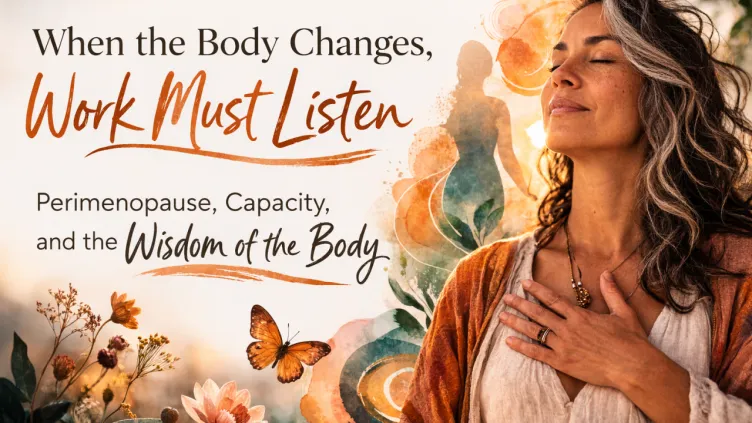
Perimenopause at Work is a Human Capacity Issue
Perimenopause is still too often treated as a private inconvenience that women are expected to manage quietly while continuing to perform as normal.
I do not think that is good enough.
Perimenopause is not only a symptom issue. It is also a capacity issue. It can affect energy, sleep, focus, emotional steadiness, confidence, and a woman’s sustainable ability to carry work and life without significant inner cost.
That matters not only to women, but also to managers, colleagues, schools, organisations, and companies that want a more humane and more intelligent understanding of performance.
Visible performance can hide invisible strain
One of the reasons this subject is so often misunderstood is that visible performance can continue while invisible reserves are being steadily drained.
A woman may still be teaching, leading, delivering, caring, and coping. She may still look competent from the outside. But she may be doing all of that at a far greater inner cost than anyone around her can see.
Workplaces tend to read the surface. If someone is still functioning, people assume she is fine.
But visible performance and invisible depletion can coexist.
That is why perimenopause should not be reduced to a conversation about symptoms alone. It is also a conversation about what the body is being asked to carry.
Why capacity matters
This is why I keep returning to the word capacity.
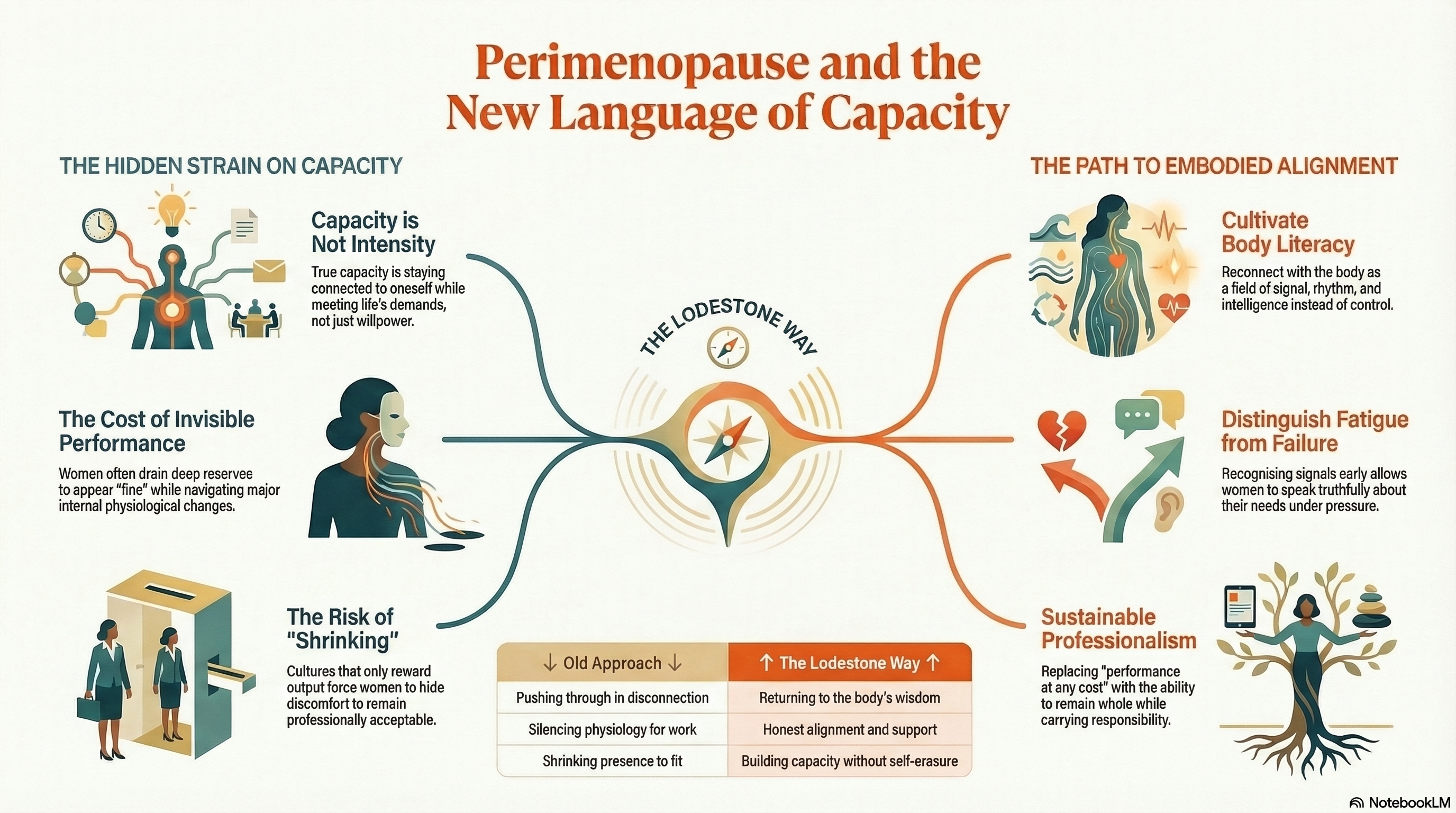
Capacity is not intensity.
It is not willpower.
It is not pushing through.
It is not professional appearance.
Real capacity is the sustainable ability to meet demand without abandoning the body.
It is the ability to remain in relationship with breath, sensation, discernment, emotion, and inner truth while life asks more of you. That is a very different standard from merely looking composed.
In professional life, that distinction matters enormously.
Because many women are not only doing their jobs. They are also regulating rooms, managing relationships, carrying emotional weather, adapting to constant change, and maintaining continuity for other people while their own physiology is shifting significantly.
The wider workplace picture matters
Recent Gallup data on full-time employed women in the U.S. help underline a wider truth relevant here. Gallup reported that women showed higher engagement than men, stronger motivation for career growth, and yet also higher burnout. Its Q4 2025 data showed women at 34% engagement versus 28% for men, 20% saying they were extremely motivated to explore career growth versus 16% of men, and 31% saying they “very often” or “always” feel burned out at work versus 23% of men. Gallup is not writing specifically about perimenopause, but it does reinforce the broader point that women can be highly engaged, highly committed, and still carrying more strain than others can see.
That matters for women approaching leadership as much as for women already in senior roles.
Ambition can remain strong while capacity is under pressure.
Women should not have to shrink to remain credible
One of the things that troubles me most is the subtle pressure many women feel to shrink during this phase of life.
To explain less.
To hide more.
To normalise fatigue.
To keep embodied change invisible in order to remain acceptable.
I do not think women should have to disconnect from their bodies in order to remain professional.
I also do not think they should have to wait until collapse before receiving understanding.
Perimenopause does not reduce a woman’s value. But it may mean that the old way of carrying life is no longer sustainable.
That is not failure.
It may be an invitation to build a different relationship with the body — one based less on override and more on truthful support.
What organisations need to understand
This is not only a women’s issue. It is a leadership and culture issue.
If organisations want to retain experienced women, support healthy leadership, and reduce unnecessary burnout, they need to become more intelligent about the embodied realities of work.
That means understanding that:
a woman may still be functioning well while carrying invisible physiological strain
support must go beyond token wellbeing gestures
managers, including men, need enough understanding to respond with respect rather than discomfort or dismissal
sustainable performance depends on human capacity, not endless self-override
The point is not to pathologise women.
The point is to stop pretending that professionalism requires disconnection from physiology.
What Lodestone offers
Lodestone is not a medical treatment. It is not a diagnostic model, and it is not a substitute for clinical care.
What it offers is something different: a way back into relationship with the body from the inside.
That matters profoundly during perimenopause.
When a woman feels foggy, overheated, emotionally closer to the surface, unsettled, exhausted, or unlike herself, the answer is not always more control. Often, it is better listening.
Lodestone supports body literacy, self-trust, and deeper inner alignment. It helps a woman reconnect with the body as a field of signal, rhythm, and intelligence. That can help her notice stress earlier, distinguish fatigue from failure, and recognise more clearly what steadies her and what depletes her.
For women who need shorter, focused support, the 30-minute Recalibration offers a more immediate space to return to steadiness, clarity, and embodied contact.
A more humane standard
A woman should not have to silence her physiology in order to remain professional.
She should not have to shrink her presence in order to stay credible.
And she should not have to wait until collapse before receiving understanding.
A more humane organisation will not treat perimenopause as an awkward side issue. It will recognise it as part of the wider conversation about human capacity, women’s wellbeing at work, and the conditions required for sustainable contribution.
That is where a more intelligent workplace begins.

Lodestone Inside supports organisations that want a more embodied, humane conversation about women’s wellbeing at work. For deeper individual support, Lodestone 1 develops body literacy and self-trust, and the 30-minute Recalibration offers focused one-to-one support when things feel too much.