The Over-Braced Workplace: How Unnecessary Effort Creates Burnout Risk
The Over-Braced Workplace: How Unnecessary Effort Creates Burnout Risk
Gravity, posture, and the practical mechanics of sustainable capacity at work.
Most people hear gravity and assume it has nothing to do with working life.
Astronauts. Physics. The “gravity” of a situation.
But gravity isn’t theoretical. It’s constant. It’s intimate. It’s happening now: keeping you on the earth, giving weight to your body, offering support through the chair and the floor.
Here’s the surprise that matters for organisations:
Many professionals spend the day fighting support.
Not loudly. Not consciously. Through micro-tension patterns that look like “being on it,” but behave like a slow leak of human capacity. Over time, those patterns become fatigue, meeting drag, decision slowdown, and burnout risk.
[YOUR OPENING STORY PLACEHOLDER — 5–8 lines]
A short story about when you first realised “grounding” is not a vibe — it’s mechanics (Alexander, voice teaching, performers, chronic workplace tension, etc.).
Grounding isn’t “feet on the floor”
“Grounding” is often used as a vague label: calm down, be stable, stop overthinking.
But you can have your feet on the floor and still be braced from head to toe.
A more useful definition is this:
Grounding is the ability to transfer load into support without unnecessary force.
That’s not personality. It’s skill.
It means you can let the chair take you, let the floor support you, let breath widen you — without bracing, gripping, or holding yourself up.
When support feels safe, effort reduces. Breath settles. Attention becomes steadier. And clarity returns.
A simple diagnostic: the pen-grip test
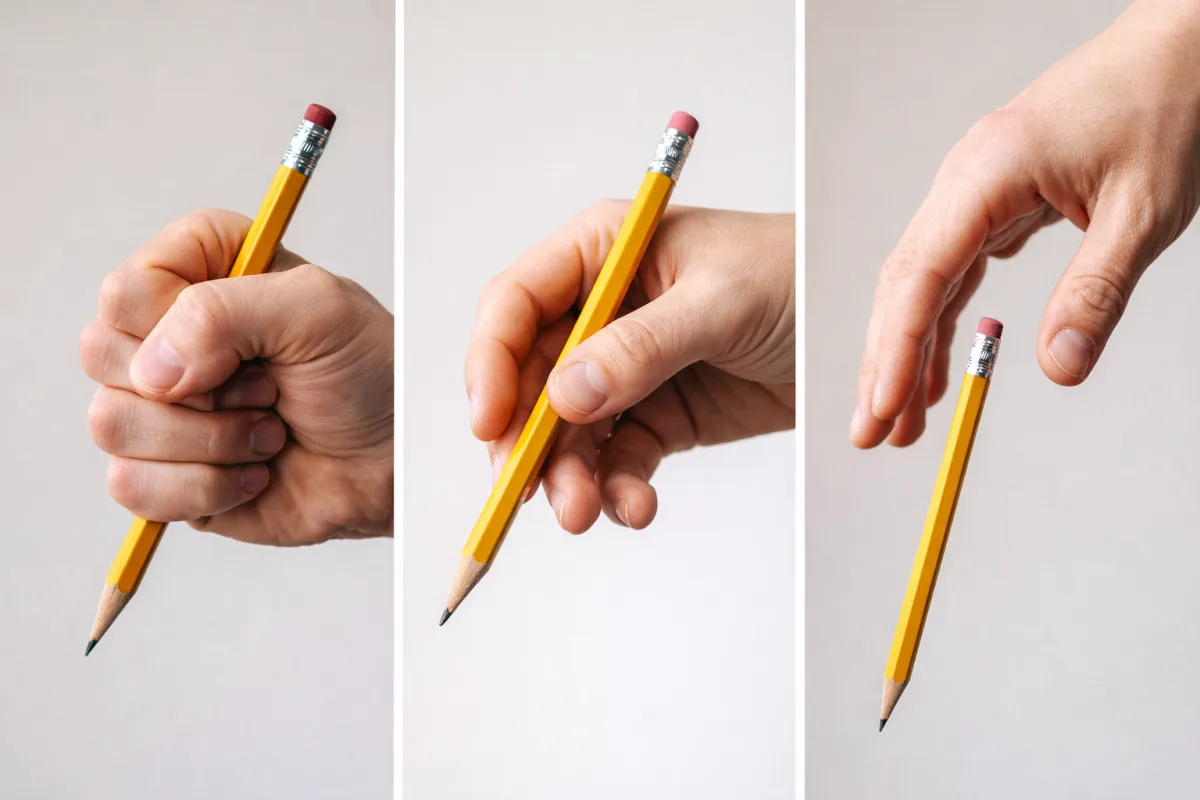
Hold a pen as if you’re about to write. Now notice:
how hard your fingers grip
what happens in your wrist/forearm
whether your shoulder rises
whether your jaw tightens
what happens to your breath
Most people use far more force than necessary—sometimes many times more than the pen requires.
Now reduce your grip by 10–20%. The pen usually doesn’t fall.
But the body often reacts as if release is unsafe.
That reaction is the doorway.
Because the same “force habit” appears everywhere in modern work: typing, scrolling, writing emails under pressure, presenting, “listening” while internally braced, maintaining a professional face while anxious.
Unnecessary effort starts in the hands, then spreads through the system.
What over-bracing looks like (and why it matters)
Over-bracing is a body strategy: the subtle muscular holding that keeps a system together when it doesn’t trust support.
Common signs:
held breath / shallow breathing
tight jaw and tongue
lifted shoulders / braced neck
rigid spine (not strong—rigid)
tight belly
clenched hands
It often masquerades as competence. It looks like alertness. It can even be rewarded.
But it drains capacity because the body spends energy simply to maintain itself.
Burnout risk becomes much less mysterious when you see this clearly:
Chronic over-bracing is unsustainable.
Why this creates organisational cost
Unnecessary effort is not only an individual issue. It becomes measurable organisational cost through:
Presenteeism: people are present but under-functioning (reduced cognitive range, less creativity, slower recovery).
Decision drag: bracing often pairs with overthinking; the system can’t downshift, so the mind compensates with analysis.
Meeting fatigue: braced rooms lose coherence—more talk, less clarity, more repetition, more exhaustion.
Absence and attrition: recovery slows; high performers quietly exit because “holding it together” becomes too expensive.
This is why generic wellbeing content often doesn’t land. Information doesn’t change mechanics. And mechanics are where the leak is.
Meetings: where gravity becomes visible
Meetings are usually treated as purely cognitive events: agenda, strategy, updates.
But meetings are also physical environments.
When people arrive braced and never truly “land,” the room becomes subtly incoherent. You can feel it:
speech speeds up
listening collapses
interruptions increase
clarity declines
everyone leaves more tired than they arrived
Meetings often fail not only because of strategy, but because the room loses coherence. And coherence isn’t only mental.
It’s embodied.
Presence isn’t polished performance
In corporate culture, “presence” is often confused with polish and control.
But real presence isn’t a persona. It isn’t theatre.
It’s coherence under load—the ability to remain natural and clear while complexity is present, without transmitting force into the room.
One of the fastest ways to restore that coherence is learning how to stop fighting gravity.
A practical gravity reset (2 minutes)
This is not therapy and not a “calming exercise.” It’s mechanics.
Use it before a meeting, before presenting, or when you notice you’re bracing.
Let the chair/floor take more load
Sit and allow weight to drop into support—without collapsing.Release one over-brace point by 2–5%
Choose jaw, hands, shoulders, belly. Reduce effort slightly. Notice the nervous system protest—then keep the release anyway.One long exhale, then slower first sentence
Not forced. Just complete. Then speak 10% slower.
This is small, but not trivial. It trains the system to accept support—exactly what burnout erodes.
[YOUR CUE PHRASE PLACEHOLDER]
e.g., “Let the furniture carry you.” / “Stop holding yourself up.”
Why this is a sustainability issue
Organisations invest in sustainability for buildings, supply chains, reporting.
But the most overlooked sustainability issue is human capacity.
When people operate in chronic over-bracing, recovery shrinks, cognition narrows, and teams become brittle. Brittle systems break.
Gravity gives a practical entry point because it is always present—and it reveals whether the system is receiving support or resisting it.
[ALEXANDER TECHNIQUE PLACEHOLDER — 4–6 lines]
A short, non-jargon bridge: semi-supine as refuge from over-bracing; length/support without rigidity; gravity as collaborator.