Why Meetings Exhaust Good Teams | ENZA and Meeting Culture | Lodestone Inside
Why Meetings Exhaust Good Teams
Most organisations do not set out to create exhausting meetings.
The people in them are often thoughtful, capable, and committed. They want progress. They want clarity. They want decisions. And yet many teams leave meetings more drained, less coherent, and more burdened than when they entered.
As a mentor, this interests me deeply because I have seen the same pattern for over 30 years in very different settings.
I have worked with students, business professionals, performers, teachers, and leaders. Long before I was speaking about human capacity in organisational language, I was already watching what happens to people under pressure. I was watching breath change, voices tighten, posture collapse, timing go off, and intelligence narrow when too much strain entered the room.
That same pattern now appears in meetings.
On the surface, it looks like a communication problem. But often it is a capacity problem being expressed through communication.
Meetings are not just about agenda
A meeting is not a neutral container.
It is a human environment. People are not only listening to information. They are also reading tone, pace, power, interruption, uncertainty, emotional charge, and whether there is enough safety to speak honestly.
This is why a meeting can look perfectly normal on paper and still leave people exhausted.
In my earlier work with performers and speakers, I learned that when the body is under pressure, range reduces. Breath becomes shallow. Listening changes. Timing changes. Expression becomes tighter. The same thing happens in professional settings, though people often do not recognise it for what it is.
They assume the problem is poor communication.
Very often, the deeper problem is that people are trying to communicate while already overloaded.
Why good teams get tired
Good teams become tired in meetings when too much is being carried at once.
Too many decisions.
Too much unresolved tension.
Too much background pressure.
Too little structure.
Too little real listening.
Too many competing agendas in one room.
The result is familiar.
Meetings go in circles.
The same issues come back again.
A few people carry the room.
Quieter people withdraw.
Strong people start compensating for the lack of clarity.
Everyone leaves with more weight instead of more direction.
This is not simply inefficiency. It is strain.
Silence is not always disengagement
One of the things I have learned as a mentor is that silence is often misread.
In schools, on stage, in training rooms, and in professional settings, people often assume that a quiet person is disengaged, unprepared, or lacking confidence.
Sometimes that is true. But often silence is a sign that the conditions are wrong.
People go quiet when the pace is too fast.
They go quiet when the room feels unsafe.
They go quiet when interruption is normal.
They go quiet when speaking costs more than it gives back.
They go quiet when they are already carrying too much.
In meetings, silence is often a clue that the room is compressing people rather than drawing out their intelligence.
That matters, because a team loses a great deal when only the fastest or strongest voices shape the outcome.
Decision drag has a cost
Another common problem is decision drag.
The topic is discussed. Then revisited. Then reframed. Then carried into another meeting.
Everyone is busy. Everyone is sincere. But the room does not convert attention into movement.
This is exhausting because it creates friction without relief. It teaches people that meetings are places where energy is spent but not properly resolved.
In embodied terms, the system does not get closure. It keeps carrying open loops.
That is tiring for individuals and expensive for organisations.
The body is in the meeting, whether we admit it or not
This is why I take an embodied view of organisational life.
The body is in every meeting.
It is there in the tone of voice.
In the rhythm of interruption.
In the speed of response.
In the quality of listening.
In the way tension spreads through a room.
In whether people leave clearer or more contracted.
A team may have a strong agenda and still fail to think well together if the human conditions are wrong.
This does not mean organisations need therapy. It means they need better observation.
If the room is overloaded, thinking narrows.
If people feel compressed, contribution drops.
If pace outruns perception, decisions weaken.
If meetings repeatedly exhaust people, the issue is not just scheduling. It is design.

What begins to help
Once leaders see meeting strain more clearly, they can start to change the structure rather than blaming the people inside it.
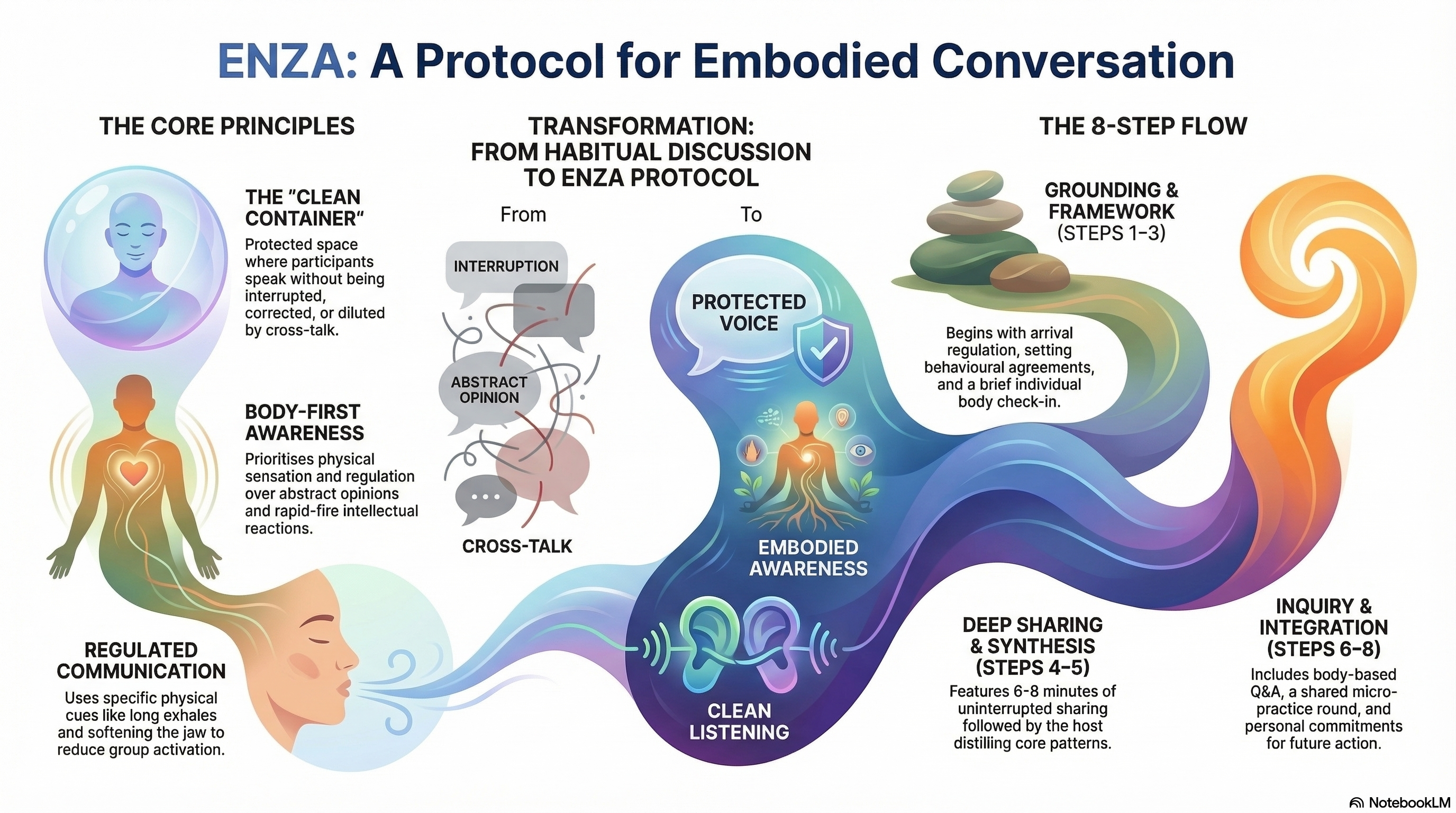
This is one reason I developed ENZA.
ENZA is not about making meetings more performative or artificially polite. It is a practical framework for creating clearer participation, more equal voice, and cleaner outcomes. It helps teams reduce interruption, surface what matters earlier, and move towards decisions with less friction and less hidden compression.
In other words, it is designed to support the human conditions that better meetings require.
Not every organisation needs a dramatic overhaul. But many do need a more intelligent meeting rhythm, a better way of distributing voice, and a structure that reduces the strain people are silently carrying.
What leaders need to notice
Leaders need to ask better questions about meetings.
Not only:
Why are we having so many?
But also:
What are these meetings asking people to carry?
Where does confusion build up?
Who is over-functioning?
Who has stopped speaking?
What tension is being normalised?
Do people leave with clarity, or with residue?
Those questions reveal far more than attendance numbers ever will.
And they also point towards solutions. If interruption, imbalance, and circular discussion are part of the problem, then the answer is not simply fewer meetings. It is better-designed meetings.
A better standard
A good meeting should not merely transfer information.
It should help a team think, decide, and leave with more coherence than it had before.
That usually requires:
clearer purpose
better pacing
cleaner decision ownership
less interruption
stronger listening
enough steadiness in the room for truth to be spoken without unnecessary cost
Frameworks such as ENZA become useful here because they help organisations move from vague aspirations about communication to actual structures that support it.
This is one reason I am interested in meeting culture. Meetings are one of the clearest places where organisational strain becomes visible. They show us whether a team has the conditions to function well together or whether it is quietly paying too high a price for ordinary communication.
Closing
Meetings exhaust good teams when communication is being asked to carry more than the human system can hold well.
That is why this is not just a productivity issue. It is a leadership issue, a design issue, and a capacity issue.
When leaders learn to read meetings more accurately, they begin to see what is really happening beneath the surface: pressure, compression, decision drag, overcompensation, and the loss of internal room.
And once those things are visible, better structures can be introduced.
That is where ENZA belongs — not as a bolt-on technique, but as part of a more humane and more intelligent way of helping people meet, contribute, and decide together.
If your meetings are taking too much energy and producing too little clarity, the Executive Briefing is a practical place to begin. It helps identify where communication strain is building and whether an ENZA-style pilot could support cleaner participation and better outcomes. You can also find out more at ENZA protocol.