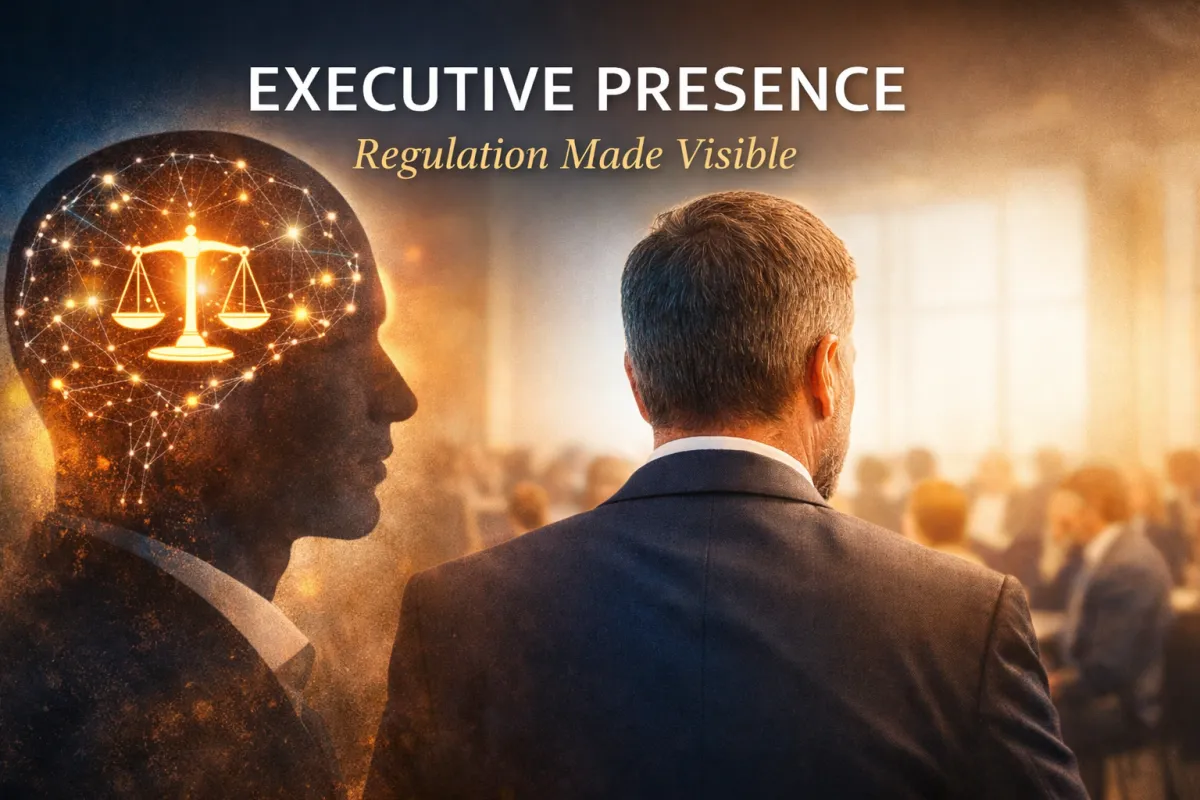
Executive Presence Is Not Performance. It Is Regulation Made Visible.
For years, I worked with performers, speakers, students, and professionals whose success depended on how they came across in the room.
What I learned very early is that presence cannot be faked for long.
A person may learn posture tricks, eye-contact techniques, presentation habits, or vocal strategies, and some of those things can certainly help. But if the internal system is disorganised, the body will eventually show it. The voice tightens. The breath shortens. The face hardens. The room feels the strain, even if nobody names it directly.
That is why I do not think of executive presence as performance.
I think of it as regulation made visible.
Presence begins before anyone speaks
In corporate life, people often speak about executive presence as though it were a style issue. They mean confidence, authority, gravitas, polish, or charisma.
But presence begins much earlier than that.
It begins with whether the person is internally organised enough to stay in the room fully. Can they think clearly under pressure? Can they listen without collapsing into defensiveness or speed? Can they remain steady when the conversation becomes difficult? Can they hold complexity without transmitting panic, urgency, or fragmentation into the people around them?
That is presence.
Everything else is secondary.
A beautifully delivered message cannot compensate for a dysregulated nervous system. People may be impressed for a moment, but they do not feel deeply assured by it. At some level, the body always reads more than the script.
The body communicates before the intellect catches up
One of the central problems in many organisations is that communication is treated as though it begins with words.
It does not.
Communication begins in state.
It begins in breath, tone, posture, timing, facial expression, and the quality of attention a person brings into the exchange. Long before anyone analyses the content of what a leader is saying, they have already registered whether that leader feels steady, rushed, defended, open, brittle, grounded, controlling, or present.
This is one reason executive presence matters so much.
Not because leaders need to look impressive, but because their internal state shapes the field around them.
If the leader enters the room carrying agitation, people feel it.
If the leader is scattered, the meeting often becomes scattered.
If the leader is over-controlled, the conversation narrows.
If the leader is steady, the room usually has a better chance of thinking.
This is not mystical. It is embodied communication.
Presence is not domination
There is also a misunderstanding in some professional cultures that presence means force.
It does not.
A person can dominate a room and still have very little real presence. They may be loud, polished, highly verbal, and outwardly confident, but if the effect they have on others is constriction, caution, or low-grade fear, then what they are creating is not presence. It is pressure.
True presence has more coherence in it.
It does not need to crush the room in order to lead it. It does not rely on constant display. It does not need endless self-assertion. Very often, the most powerful person in the room is the one whose system is organised enough to remain calm, attentive, and clear while everyone else becomes reactive.
That kind of steadiness changes things.
It improves the quality of decision-making.
It reduces unnecessary escalation.
It helps people feel safe enough to think, not merely to defend themselves.
It makes communication more intelligent.
Why regulation matters at senior level
At senior level, the stakes are higher because the influence is wider.
A leader’s state does not remain private for long. It affects how teams interpret challenge, how conflict is handled, how much truth people are willing to speak, and whether meetings become places of real thinking or merely places of managed impression.
I have seen again and again that leaders who are under strain often try to compensate by increasing control. They speak more, tighten more, rush more, and try to manage uncertainty through force of mind.
But when the body is no longer well regulated, more control from the head rarely solves the deeper problem.
It often makes the room less intelligent.
People become more careful. The atmosphere narrows. Creativity drops. The field becomes performative. Everyone is still “professional,” but much less real communication is taking place.
That is why executive presence cannot be reduced to communication skills training alone. It requires attention to the body, to the nervous system, and to the way pressure is actually being carried.
What the Lodestone view adds
The Lodestone approach has always understood that a human being is not led by the intellect alone.
If the inner compasses are not working together, presence becomes fragile. A person may still be clever, strategic, and articulate, but they will be more easily thrown by pressure, emotion, overload, or relational challenge.
When the system is more integrated, something else becomes possible.
The leader does not have to manufacture presence. They begin to inhabit it.
Their voice carries differently.
Their attention is less scattered.
Their decisions are less reactive.
Their body is less busy defending itself.
Their communication becomes more congruent because it is not split across so many competing internal signals.
That is a much more trustworthy form of leadership.
What organisations should stop doing
Organisations often try to solve presence at the surface.
They train leaders to present better, sit differently, speak with more authority, manage body language, or control perception. Again, some of this can be useful. But if the internal system remains chronically overdriven, fragmented, or disconnected, the result is often a more polished mask rather than a more coherent leader.
The costs of that are significant.
People may comply outwardly while trust quietly drops. Meetings may look efficient while real thought disappears. A leader may appear confident while transmitting stress into every process they touch.
This is why I believe executive presence needs to be redefined.
It is not image management.
It is not theatre.
It is not personality enhancement.
It is the visible expression of an internal system that is sufficiently organised to think, feel, listen, and lead without constant override.
A more human standard of authority
I am interested in a standard of leadership that is more human and more exacting at the same time.
Not leaders who can simply command attention, but leaders who can hold it wisely.
Not leaders who can dominate complexity, but leaders who can remain organised within it.
Not leaders who perform confidence while the body is in turmoil, but leaders whose authority is grounded enough to create trust.
That is a more serious form of executive presence.
And in a time when many organisations are struggling with burnout, reactivity, shallow communication, and chronic overload, it may be one of the most important capacities a leader can develop.
CTA
Lodestone Inside helps leaders and organisations develop a more embodied form of executive presence—where regulation, clarity, communication, and human capacity are treated as strategic assets, not optional extras.