
The Problem Is Not Performance. It Is Capacity.
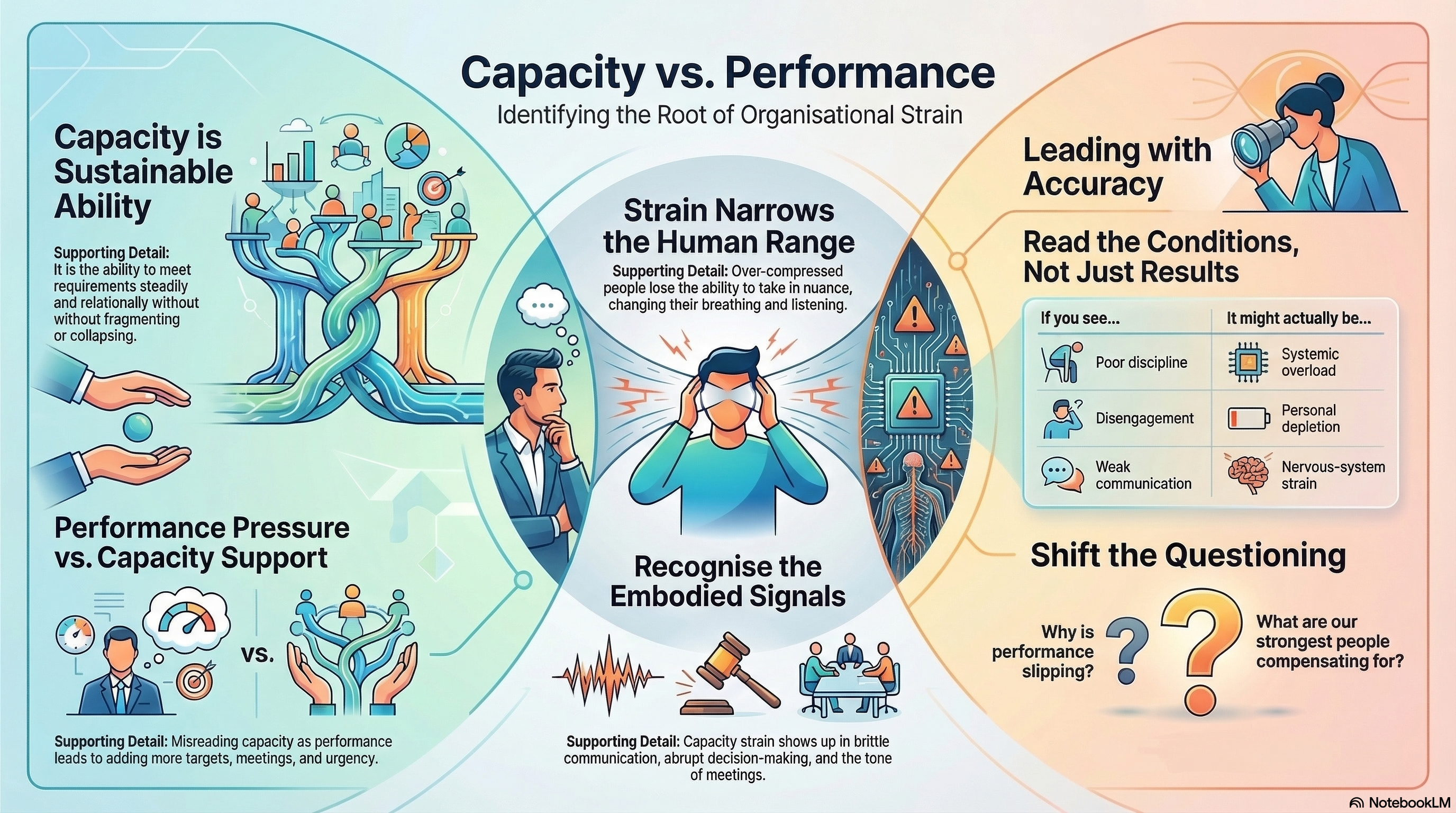
Many organisational problems are labelled as performance problems when they are actually capacity problems.
That distinction matters.
Because when we misread a capacity issue as a performance issue, we usually respond by adding more pressure: more targets, more meetings, more urgency, more correction. And that often makes the real problem worse.
As a mentor, this is something I have seen for decades.
I have worked with university students, MBA and business learners, performers, professionals, and leaders for over 30 years. Again and again, I have seen highly intelligent, committed people struggle not because they lacked ability, but because they were carrying too much strain.
They were trying to think clearly, speak well, regulate emotion, make decisions, stay relational, and perform under pressure, but without enough internal space to do so sustainably.
From the outside, this can look like underperformance.
From the inside, it is usually a capacity issue.
What I mean by capacity
Capacity is not ambition.
It is not effort.
It is not intelligence.
And it is not how much a person can override before they finally collapse.
Capacity is the sustainable ability to carry demand well.
It is the ability to stay clear enough, steady enough, and relational enough to meet what is required without fragmenting.
At individual level, that means being able to absorb pressure, think clearly, communicate well, and still have room for judgment and choice.
At leadership level, it means holding complexity without passing confusion, tension, or fragmentation into the team.
At organisational level, it means creating conditions in which people can work, decide, and relate without chronic strain becoming normal.
What taught me this
My understanding of capacity did not come from corporate theory alone.
It came from years of mentoring people whose outer performance was being shaped by inner strain.
In my earlier work, I helped people with voice, communication, posture, stage presence, and embodied expression. Later, my work deepened into embodiment, nervous-system awareness, and the question of what allows a human being to function as a whole person rather than as a pressured mind dragging a body behind it.
That pattern is the same whether someone is standing on a stage, leading a meeting, teaching a class, or trying to guide a team through change.
When people are over-compressed, their range narrows.
Their breathing changes.
Their listening changes.
Their timing changes.
Their decision-making changes.
Their ability to take in nuance drops.
This is why I do not see many so-called performance problems as isolated behavioural issues. I see them as signals.
What happens when capacity is low
When capacity drops, communication often becomes brittle.
Meetings become harder work than they should be.
People interrupt more, or say less.
Decision-making slows down or becomes abrupt.
Misunderstandings increase.
Good people begin to look hesitant, reactive, or withdrawn.
Most organisations then reach for performance language.
They say people need more accountability, greater resilience, tighter focus, or stronger execution.
Sometimes that is true. But very often the deeper issue is that the system is asking people to carry too much without enough support, clarity, or internal room.
That is not a moral weakness. It is a structural and human reality.
Why leaders need to understand this
A leader does not only need to assess results. A leader needs to read conditions.
That means learning to distinguish between:
poor discipline and overload
disengagement and depletion
conflict and compression
hesitation and lack of internal room
weak communication and nervous-system strain
This is not softness. It is accuracy.
If leaders cannot recognise capacity strain, they tend to apply more force where reorganisation is needed. They intensify pressure where steadiness is needed. They ask for better communication without noticing that the team no longer has the conditions for good communication.
That is how strong people begin to fail inside systems that keep calling for more.
The body is part of the picture
This is one reason my work takes an embodied approach.
Human capacity is not just cognitive. It is carried through the body.
A person may look functional on paper and still be operating in a narrowed, defensive, overloaded state. A team may appear productive while quietly losing coherence. An organisation may be getting results while paying too high a human price for them.
If we ignore the body, we miss some of the clearest signs that capacity is under strain.
We miss it in the tone of meetings.
We miss it in the pace of conversation.
We miss it in the quality of listening.
We miss it in the way decision pressure spreads through a team.
And once those signals are missed, the organisation often starts solving the wrong problem.
Better questions
Instead of asking only, “Why is performance slipping?”, leaders need better questions:
What are people being asked to carry right now?
Where is decision strain accumulating?
What has become harder than it should be?
What are our strongest people compensating for?
Where are we normalising compression?
What would help this team carry its real work more sustainably?
Those questions lead to better decisions.
They shift the conversation away from blame and towards reality.
A more useful way forward
In my work as a mentor, I am interested in helping people and organisations recover clarity from the inside out.
That means looking at human capacity, communication patterns, meeting strain, decision rhythm, and the embodied conditions that affect how people actually function.
Because the real issue is often not that people do not care enough.
It is that they are carrying too much, too tightly, for too long.
And when that happens, what looks like a performance problem is often a signal that capacity needs attention.
Closing
The problem is not always performance.
Often, it is capacity.
If leaders can understand that difference, they make better decisions about people, meetings, pace, communication, and change.
And that is where more humane, more intelligent working begins.